
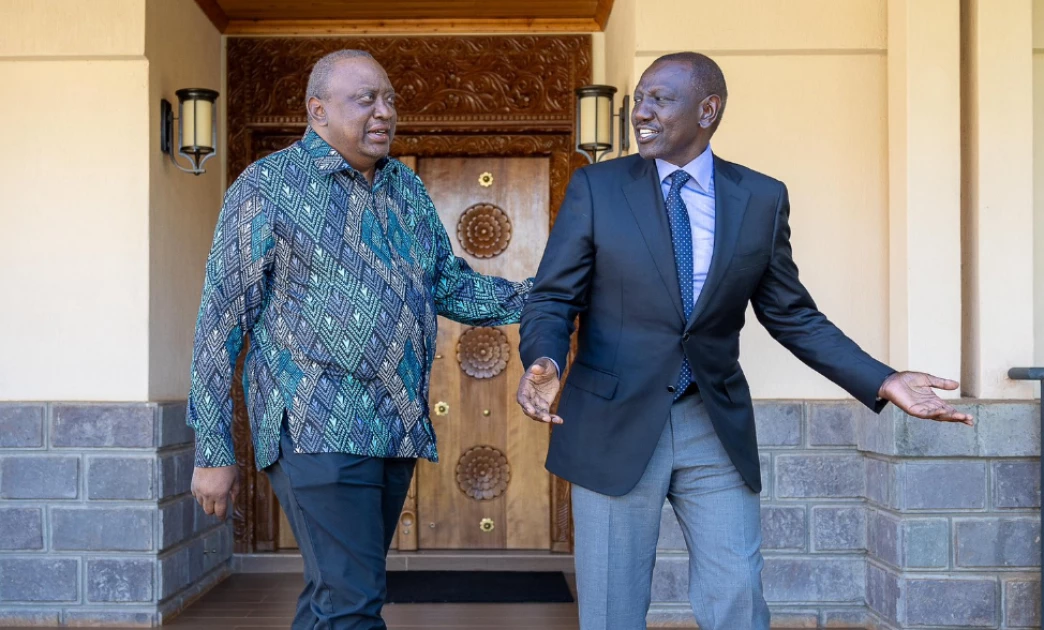
President William Ruto has revealed details of a meeting he held with former President Uhuru Kenyatta at the height of the Gen Z protests in 2024, saying he had approached his predecessor for guidance on how to steer the country through a difficult period.
Ruto said he made the effort because he believed former presidents had an important role to play even after leaving office. According to him, former leaders can help provide direction, promote national unity and guide the country as it prepares a new generation of leaders.
The President said he personally sought out Uhuru at his Ichaweri home and also tried to engage him at his Nairobi office. He said his intention was to ask the former Head of State to contribute to a broader national vision at a time when the country was facing strong public pressure and political tensions.
“I went out of my way and looked for him first in Ichaweri and his office here in Nairobi and asked him, as a former Head of State, the only one living, he should help us to forge a new vision for the country, but he was reluctant and said he wasn’t sure he wanted to do that,” Ruto stated.
Ruto said Uhuru was free to make his own decision on whether to take part in efforts to support his administration. He claimed that instead of taking up what he described as a statesman role, the former president chose to remain active in opposition politics.
“Those are choices that people make. Of course, he chose to do what he is doing, organising the opposition and sponsoring them,” he added.
The comments have brought renewed attention to the relationship between the two leaders, who once worked closely under the Jubilee administration before their political relationship deteriorated.
Ruto served as Uhuru’s deputy for two terms between 2013 and 2022. However, their relationship became increasingly strained during Uhuru’s second term, particularly after the former president began working with opposition leader Raila Odinga.
The political differences between the two later became more visible during the 2022 General Election, when Uhuru supported Odinga’s presidential bid while Ruto contested the election under the United Democratic Alliance ticket.
Ruto has now accused Uhuru of continuing to play a role in opposition politics and alleged that the former president has been involved in efforts aimed at putting pressure on his administration as the country moves closer to the 2027 General Election.
“My predecessor had an option to become a statesman, but he chose to become an opposition leader. He is the chairperson of the Azimio Coalition and he is busy organising the opposition against me,” the president noted.
Uhuru has, however, rejected claims that he is sponsoring the opposition or seeking to influence the country’s political leadership for personal political gain.
The former president has repeatedly maintained that he has no interest in returning to elective politics. He has instead said that the decision on who should lead the country belongs to ordinary Kenyans and should not be imposed by political leaders.
“It’s the people who will decide. If they say it is Kalonzo, Ruto, Matiang’i, or Sifuna, it will be so. I don’t want to be called a sponsor; I have just said the power belongs to the people,” Kenyatta stated.
The exchange between the two leaders comes as political activity gradually intensifies ahead of the 2027 General Election. Their contrasting accounts also highlight the continued political differences that emerged after years of working together in government.
Ruto’s account of the 2024 meeting provides a glimpse into his attempts to seek engagement with his predecessor during a period marked by widespread youth-led protests and growing public concern over the direction of the country.
Uhuru’s response, meanwhile, places emphasis on the role of voters in determining Kenya’s political future. The former president has maintained that Kenyans should be allowed to choose their leaders without being directed by individuals or political groups.
The disagreement between the two former allies is therefore likely to remain part of the wider political conversation as parties and political leaders position themselves ahead of the next General Election.