
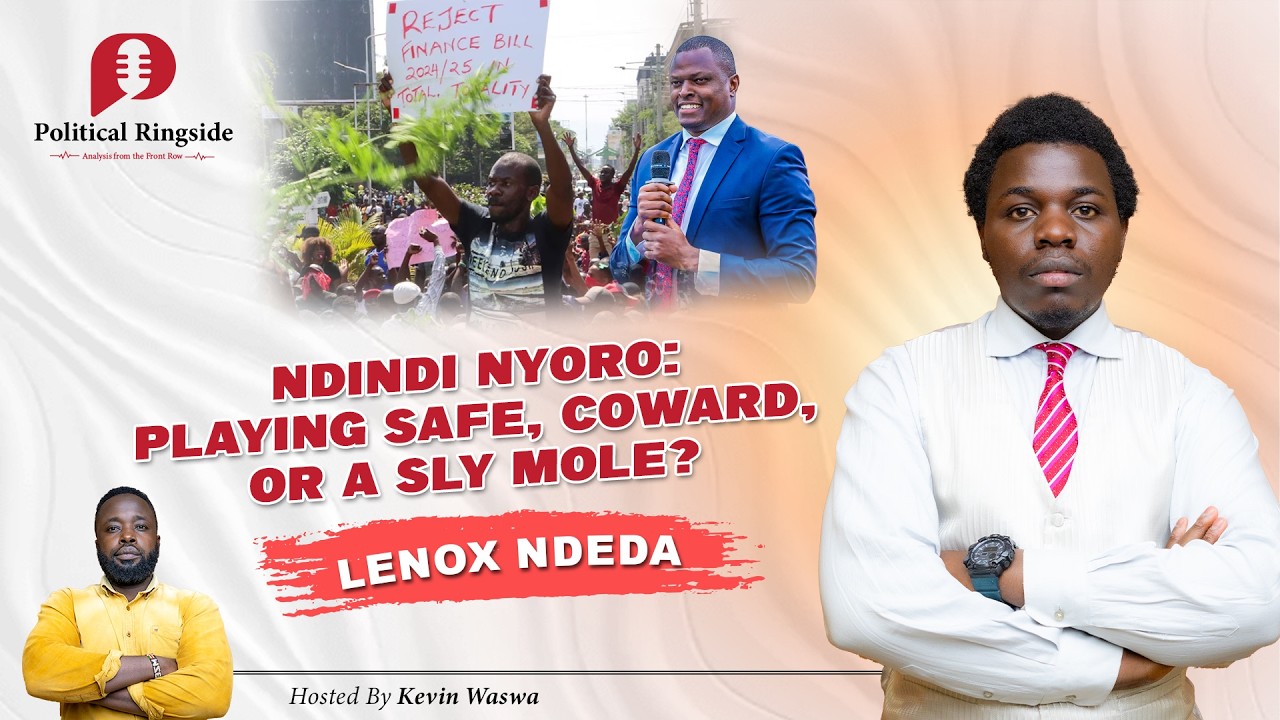
Kiharu Member of Parliament Ndindi Nyoro is facing renewed political scrutiny after a hard-hitting Political Ringside interview questioned whether his public image as a defender of ordinary Kenyans matches his conduct during key parliamentary moments.
In the interview hosted by Kevin Waswa, engineer and political commentator Lenox Ndeda criticised Nyoro over his absence during the Finance Bill 2026 vote, arguing that the MP has built a strong public brand around economic commentary but failed to register his position when the matter reached the floor of the National Assembly for a decisive vote.
The Finance Bill 2026 was passed after 122 MPs voted in favour, while 40 voted against it. However, the bigger political debate has shifted to the large number of lawmakers who skipped the vote, despite the Bill being one of the most consequential pieces of legislation of the year.
For Ndeda, Nyoro’s absence raises a sharper question about representation. He argued that MPs cannot speak strongly in rallies, media interviews and press conferences, then disappear when their vote is required on tax measures that affect households, businesses and the cost of living.
Political Ringside criticism
During the Political Ringside episode, Ndeda described Nyoro’s style as “post-truth populism”, accusing him of riding on public anger while failing to fully execute his legislative duty at the most critical stage.
According to Ndeda, the problem is not that Nyoro lacks knowledge of economic issues. The problem, he argued, is that the Kiharu MP knows the issues well enough to speak about them publicly, but his absence during key votes weakens the credibility of that public posture.
The commentator also pointed to what he described as a pattern of absence during politically sensitive moments, including previous Finance Bill processes and the impeachment of former Deputy President Rigathi Gachagua.
Nyoro has since explained that he missed the Finance Bill 2026 vote because he had travelled out of the country for engagements he said could not be postponed. He also admitted that the explanation should not absolve him from blame.
That admission, however, has not stopped critics from asking why an MP who has repeatedly spoken on taxation, fuel prices, public debt and government spending was not present when the record mattered most.
Finance Bill politics
The Political Ringside discussion also contrasted the Finance Bill 2026 with the heavily contested Finance Bill 2024, which triggered nationwide protests led largely by young Kenyans.
Ndeda argued that the 2024 backlash was fuelled by poor communication, defensiveness and failure by government officials to properly explain the budget and tax proposals to the public. In his view, the 2026 Bill passed not because it was necessarily softer, but because the political management around it was different.
He also faulted the broader parliamentary culture, saying many lawmakers treat crucial sittings casually while prioritising public rallies, funerals and political mobilisation. The criticism cuts across both government and opposition MPs, because absence from voting allows leaders to avoid taking a clear public position.
For voters, that creates a democratic problem. A lawmaker can later claim sympathy with public anger without having voted against the law that caused that anger.
Nyoro’s political test
Nyoro remains one of the most visible MPs from the Mount Kenya region and has often been projected as a possible future national player. His development record in Kiharu and his command of economic language have helped him build a strong following.
But the Political Ringside interview warns that popularity is not a substitute for parliamentary discipline.
Ndeda argued that Kenya’s 2027 political conversation should not be driven by roadside declarations, tribal kingpin politics or emotional speeches. Instead, he said voters should judge leaders by whether they read Bills, attend crucial sittings, debate competently and vote when national decisions are made.