
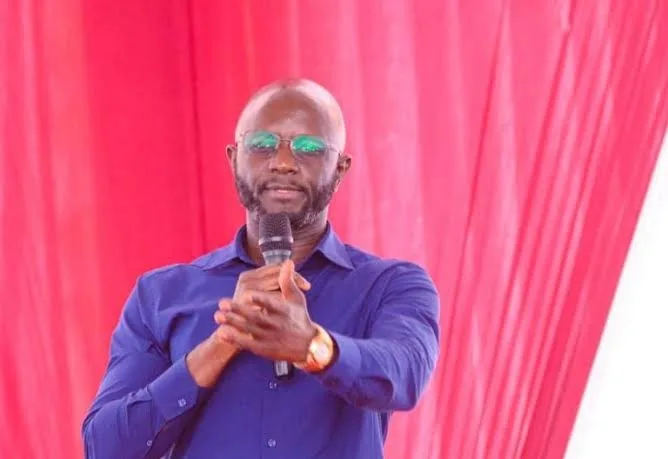
There is a particular kind of arrogance that settles into a Kenyan politician once state security is assigned to him, and Samuel Atandi is fast becoming its poster boy.
The Alego Usonga MP and chairperson of the National Assembly Budget and Appropriations Committee has spent the better part of July and August 2026 telling the same youths who put him in Parliament to keep their distance, book appointments, and stop treating him like one of their own. What he frames as a demand for order is, when the record is laid bare, the confession of a man who has forgotten who made him.
The trigger was a series of public remarks Atandi made in Siaya in early July. He complained that youths from Ugunja, Ugenya and Gem had taken to showing up uninvited at his engagements and trailing his government vehicle, and he contrasted their conduct with the calm reception he received when he flew into a church fundraiser in Nandi County by helicopter.
He told residents that once he is inside his official car, he is under the protection of armed officers, and that anyone who gets too close risks being mistaken for a threat.
It was less a request for civility than a warning shot, delivered by a man who now moves by air while the people who elected him queue on foot for an audience.
The remarks landed at the worst possible moment. Days earlier, 28-year-old youth mobiliser Cecil Ouma had been shot dead inside the vehicle of Youth Affairs Principal Secretary Fikirini Jacobs along Park Road in Nairobi, after approaching the car to collect reimbursement for youths he had mobilised for a government forum in Kariokor.
A post-mortem confirmed he died of a single gunshot wound to the chest. Fikirini’s bodyguard, Rashid Charo, was arrested and freed on a modest bond as investigations continued, with the matter still open as of this month.
The killing became a national flashpoint precisely because it exposed how casually the state’s armed escorts can turn on the same young people they are meant to be serving. For Atandi to issue his own warning about surrounding vehicles and trigger-happy security officers in that exact climate was either staggering tone-deafness or a calculated attempt to pre-emptively excuse whatever his own detail might do to a Siaya youth who gets too close.
Residents did not receive it kindly. A section of Alego Usonga constituents branded him power-drunk, accusing him of ridiculing the boda boda operators who form the backbone of his political base as desperate beggars who trail him for cash.
He reminded them, on camera, that he now sits in one of the most powerful seats in Parliament and enjoys state protection, and that he would not hesitate to let his bodyguards deal with anyone he considered disruptive.
Critics across Siaya County have not let the moment pass quietly, repeatedly urging him to look at his predecessor in the Budget Committee chair, Kiharu MP Ndindi Nyoro, who they say wore the same influence without losing his accessibility.
The comparison is instructive precisely because it is so unflattering to Atandi. Nyoro used the Budget Committee chairmanship to build a visible development record in Kiharu, overhauling public primary schools, cutting day secondary fees, introducing feeding programmes, building laboratories and establishing new schools, all while remaining reachable to his constituents.
Atandi, holding the identical office with the identical national leverage, has instead produced a stream of viral images of decay. In January 2026, photographs of the crumbling classrooms at Uwasi Primary School circulated widely, prompting lawyer Willis Evans Otieno to describe the structures as frozen in 1988.
Atandi’s response was to dismiss the images as propaganda and political mischief rather than address them, a reflex that only deepened the backlash once further images surfaced of neglected facilities at Nyadhi Primary and the once-prestigious Barding Boys High School.
A man who chairs the committee that decides how the entire country’s development budget is allocated could not, or would not, replicate in his own backyard what his predecessor achieved in Kiharu. The irony writes itself: helicopter arrivals and tailored shirts in the foreground, collapsing classroom roofs in the background.
Atandi’s rise to this position was itself a product of the broad-based government arrangement between President William Ruto and ODM leader Raila Odinga, which handed him the Budget Committee chairmanship in March 2025. He has used the platform aggressively, but rarely in the direction of scrutiny.
As chair, he presided over hearings in which Auditor General Nancy Gathungu told his own committee that there was no evidence to support claims that Sh6 billion in Hustler Fund loans had become unrecoverable, a damning exchange over one of Ruto’s flagship programmes that exposed exactly the kind of unaccountable spending Atandi’s committee exists to catch.
Rather than building a reputation as a fiscal watchdog, he has spent his political capital defending government borrowing and attacking elected officials who ask the same questions he is supposed to be asking.
Nowhere is that double standard sharper than in his running feud with Siaya Governor James Orengo. Atandi has repeatedly branded Orengo’s county leadership a failure and accused him of sabotaging national development for opposing the broad-based government, even while urging Siaya’s own MCAs to abandon impeachment proceedings against the governor on the grounds that voters, not the assembly, should decide his fate. He has simultaneously positioned himself as having already anointed a preferred successor to Orengo ahead of the 2027 elections, a level of political engineering that sits oddly beside his public posture of humble public service.
The same MP who tells Alego Usonga youths to stop crowding his car has no trouble crowding into Siaya’s succession politics years ahead of schedule.
It is worth remembering how Atandi got here. A former banker who worked his way through Standard Chartered, Bank of Africa, NIC and National Bank of Kenya before entering Parliament in 2017, he built his early career on the same youth mobilisation machinery he now treats as an inconvenience. He survived a bruising 2022 re-election fight through ODM primaries turbulence with the backing of the boda boda operators and mobilisers he now calls beggars. That machinery does not evaporate because a man acquires a helicopter and an armed detail.