
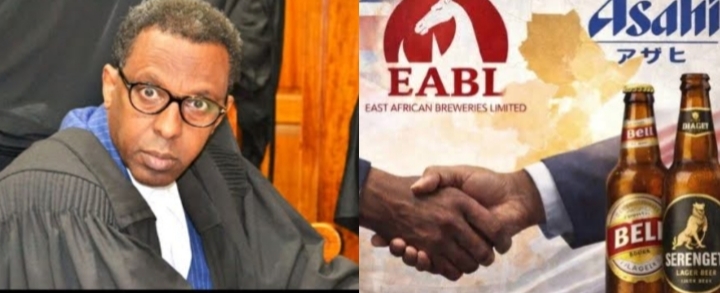
Senior Counsel Ahmednasir Abdullahi has dropped a bombshell that lays bare the rot at the heart of Kenya’s corporate and judicial systems.
His accusation is chillingly simple: the endless court cases and injunctions blocking the Kshs 340 billion EABL-Asahi deal are nothing more than a shakedown. This is not about the law. This is about pure, unadulterated extortion.
In a blistering social media post, Abdullahi did not mince his words. He stated that Asahi Group Holdings from Japan and Diageo from the UK, who are trying to acquire a 65% stake in EABL, should simply “do the needful and BRIBE the right parties.”
His message to the multinationals was direct and damning. The endless litigation and regulatory hurdles are a deliberate strategy. Some powerful individuals simply cannot allow a deal of this magnitude to pass without securing their cut. His concluding remark, “this is Kenya bwana… lipa pesa,” meaning “pay money,” was a stark indictment of a system held hostage by greed.
At the centre of this legal quagmire is Lady Justice Josephine Mongare. She is the judge who recently issued conservatory orders halting the entire transaction following a constitutional petition by a private citizen .

Justice Josephine Mong’are: photo Courtesy/X
Her court is now the arena where the fate of this monumental deal hangs in the balance.
However, Lady Justice Mongare is no stranger to controversy. She herself is under a legal cloud, having recently secured orders from the High Court to stop the Ethics and Anti-Corruption Commission (EACC) from investigating her over a Kshs 1.9 billion loan dispute involving former Cabinet Secretary Raphael Tuju .
Furthermore, senior lawyer Nelson Havi has formally complained to the Judicial Service Commission, accusing Lady Justice Mongare of gross misconduct and incompetence in handling other cases, even calling for a tribunal to be formed to remove her from office.
In the court of public opinion, she has been linked to the viral term “JuriPESA,” a portmanteau of “judiciary” and “pesa” (money), which alleges financial influence within her court .
These are serious allegations paint a troubling picture of a judge at the centre of a storm of corruption allegations while handling one of the most consequential corporate deals in Kenyan history .
This raises a terrifying question: have corrupt mafias completely taken over Kenya’s corporate and judicial systems? If a senior legal mind can make such an allegation publicly, and if it is juxtaposed with accusations against the very judge handling the case, what does it say about the state of our institutions?
Why is the judiciary entertaining these obvious games? Why are courts allowing themselves to be used as tools to frustrate a clean, commercial transaction for the benefit of a few corrupt individuals?
The integrity of our entire legal framework is now in question.
The consequences of this alleged corruption are catastrophic. A deal worth Kshs 340 billion is not just a business transaction; it is a lifeline for the Kenyan economy. It promises significant foreign direct investment, job creation, and a powerful signal to international markets that Kenya is a safe place to do business.
But what message does this ongoing circus send? It tells the world that Kenya is a place where the rule of law is for sale, where contracts are meaningless, and where you must pay a bribe to get what is rightfully yours. Justice Mongare is now the face of this moment, and her reputation is intertwined with the outcome of this case.
This is not just about EABL or Asahi. This is about the future of this country. If we allow such blatant extortion to succeed, we are setting a dangerous precedent.
Every major deal will be subject to the same parasitic behaviour. The cost of doing business will skyrocket, investors will flee, and the Kenyan people will suffer.
These allegations, including those swirling around the judge, must be investigated with the seriousness they deserve. The individuals behind this corruption, if found guilty, must face the full force of the law.
There can be no room for compromise. We must defend our institutions and reclaim our country from those who seek to destroy it for their own selfish gain.