

Johnson Sakaja’s administration is under renewed scrutiny after a report raised concerns about how Nairobi County has been managing public funds, especially on foreign travel spending by his cabinet. In Nairobi, questions are now emerging over whether the county’s leadership is aligning its spending with its stated need for financial discipline.
The Controller of Budget, through its recent findings, highlighted a pattern where County Executive Committee members continued to spend heavily on international trips at a time when the county faces serious revenue shortages and growing unpaid bills.
Between September and October 2025 alone, CEC members reportedly spent Ksh.78.16 million on travel abroad, a figure that stands out against the county’s own financial constraints.
Several of the trips were to major international destinations and events. Two officials travelled to Fujian Province in China, followed shortly by another delegation that attended the BRICS Urban Future Forum in Russia. In the United States, multiple delegations attended the 80th Session of the United Nations General Assembly in New York, with different groups incurring separate costs for attending the same event.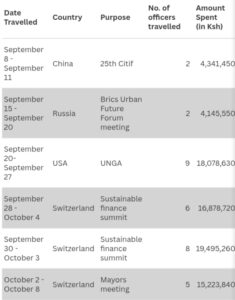
Additional trips were recorded in Switzerland, where several CEC members attended meetings and summits focused on sustainable finance and mayoral cooperation, each delegation accounting for significant expenditure.
At the same time, domestic travel costs for both the County Executive and the County Assembly were also substantial, further adding to the overall burden on public resources.
The Controller of Budget noted that these expenditures come at a time when the county is facing difficulties in raising its own revenue.
According to the report, Nairobi County collected only Ksh.5.31 billion against a target of Ksh.21.18 billion, representing about a quarter of the expected income.
This shortfall has affected the county’s ability to fund development projects, which saw low absorption levels during the period under review. Only Ksh.859.4 million was spent on development, reflecting limited progress in project implementation.
The situation is further complicated by a growing stock of pending bills, which stood at Ksh.80.04 billion by the end of December 2025. The report also pointed to weaknesses in financial management systems, including the use of manual payroll processes for large payments, which may expose public funds to risk.
Delays in submitting financial reports and gaps in oversight of county bank accounts were also noted.
In addition, the report indicated that there is no clear human resource plan in place to help manage and reduce the wage bill, a factor that continues to strain the county’s finances. These governance and operational gaps have raised concerns about accountability and long-term sustainability.
The Controller of Budget has urged Nairobi County to strengthen its financial controls, improve revenue collection, and prioritize spending on development rather than administrative and travel expenses.
With Nairobi Nairobi being a key economic hub, the findings are likely to keep public focus on how county resources are managed, especially as the government works to balance development needs with fiscal responsibility.