
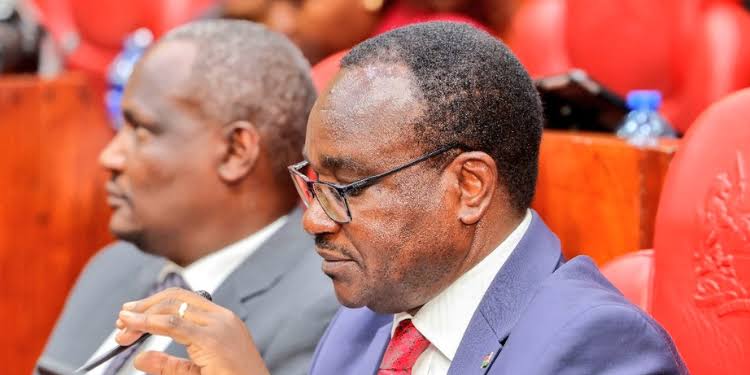
Members of the Senate Committee on Labour and Social Welfare have raised serious concerns over a growing pension crisis at the Technical University of Kenya, where unpaid retirement benefits have now reached billions of shillings. The lawmakers have turned their attention to both the Ministry of Education and the National Treasury, questioning delays that have left many former staff without their dues.
During a session held on Thursday, April 23, the committee noted that although there has been visible progress in verifying pension records, the actual release of funds has not followed. This has created a difficult situation where retirees remain unpaid despite administrative steps moving forward. The committee, chaired by Julius Murgor, heard that the verification process is nearly complete, with only the final report pending.
Long’et Terer, who is overseeing the pension scheme as liquidator, told the committee that most records have already been cleaned and validated. He assured senators that a comprehensive report would be ready before the end of the month. However, lawmakers made it clear that verification alone does not solve the problem if the funds are not released to those who depend on them.
The situation on the ground appears to be worsening. Vice-Chancellor Benedict Mutua described the pressure faced by the university, saying pensioners frequently gather outside his office seeking answers. According to him, some retirees have developed stress-related health issues while waiting for their payments, with cases of high blood pressure reported among those queuing for assistance.
Mutua explained that the university had already fulfilled its part of the agreement and is now waiting on the government to deliver on its commitments. A return-to-work deal signed on March 17, 2025 required the state to release an initial Ksh500 million to support the pension scheme, but this has not yet been done.
Union representatives also expressed frustration. Fred Sawenja, speaking on behalf of staff, accused the Ministry of Education of prolonged underfunding and inaction. He revealed that the pension liability stood at Ksh4.2 billion at the time of the agreement but later rose to Ksh6.2 billion and could be even higher now. Although funds had been promised in subsequent budgets, including allocations for the current financial year, the money has not been released.
The committee has now resolved to summon the Cabinet Secretary for Education and officials from the National Treasury to explain the delays and present a clear plan to resolve the crisis.
Concerns about financial management in public institutions have also emerged elsewhere. Kandara Technical and Vocational College recently faced scrutiny over its fee collection practices after appearing before the Public Investments Committee on Education and Governance. An audit showed that the college collected only Ksh41.3 million, about 49 percent of billed fees, leaving a significant balance unpaid.
College officials defended their position, explaining that much of the outstanding amount is tied to delays in government disbursements such as capitation, loans, and bursaries. They maintained that continuing to offer training services despite unpaid fees is necessary to avoid disrupting students’ education, especially under the current government funding framework.