
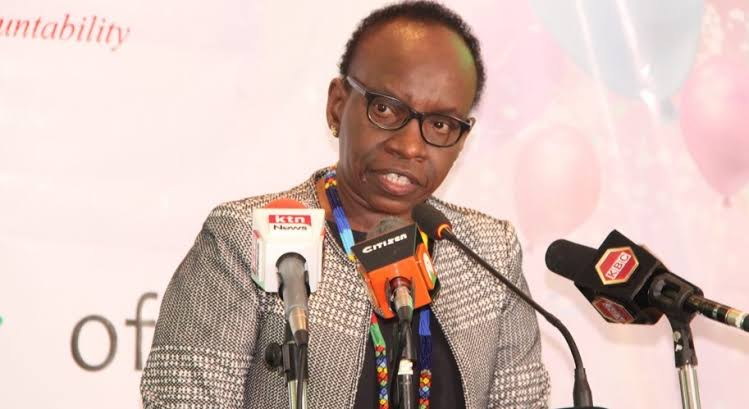
Nancy Gathungu has raised serious concerns about how bursary funds under the National Government Constituencies Development Fund Board are being managed, pointing to long-standing weaknesses that have affected students across the country.
Her audit, which reviewed the past five financial years, shows a pattern of delays, unfair distribution of funds, and weak monitoring systems. According to the findings, billions of shillings meant to support education have not always reached the intended beneficiaries in a timely or fair manner.
Gathungu noted that the board lacks a proper system to track bursary allocations.
“The board does not maintain a master list and cannot confidently account for the bursary funds disbursed over the years,” she said, highlighting major accountability gaps.
This absence of clear records has made it difficult to know exactly who benefits from the funds and whether the support reaches those most in need.
The audit further revealed that bursary funds are often distributed without careful assessment of students’ financial situations.
In many cases, students from low-income families receive the same amounts as those from more stable backgrounds. This approach, the report suggests, weakens the purpose of the fund, which is meant to support vulnerable learners and improve access to education.
Monitoring was also found to be lacking. In several instances, there was no follow-up to confirm whether students who received bursaries were actually attending school.
This raises the risk of misuse and reduces the overall impact of the program.
Delays in disbursing funds have created additional challenges. Money frequently arrives after the school term has already started, forcing some students to stay at home due to unpaid fees. This disrupts learning and affects academic progress.
“Ultimately, the lost class time results in an economic loss, and the Fund’s objective of enhancing learner retention is compromised,” Gathungu explained.
The report also pointed out inefficiencies in the continued use of physical cheques, which contribute to errors, added costs, and further delays in processing payments.
The audit covered 23 constituencies, including areas in Nairobi, Kirinyaga, and Narok. During the period under review, Ksh 243.5 billion was allocated to the fund, with Ksh 55.72 billion spent on bursaries for about 4.9 million learners, while Ksh 10.09 billion went toward administrative expenses.